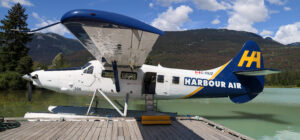
On Wednesday 13 August 2025, I had the pleasure of flying a scenic flight onboard a De Havilland Canada DHC-3T Turbine Otter seaplane operated by Harbour Air. I had never flown on a seaplane before so I was quite thrilled to see what it would be like, not only to fly over one of Canada’s most breathtaking mountain sceneries, but also to take off and land on a runway made out of nothing else but water.
Here is my detailed trip report, so you can relive this scenic flight in British Columbia, Canada. So fasten your seatbelt, set flaps for takeoff, check that the water rudders are up and enjoy this trip report.
Preparations
My personal ambition to fly on a seaplane wasn’t exactly new. As a matter of fact, it has been on my bucket list for as long as I can remember. More specifically, in 2006, i.e. almost twenty years ago, I visited British Columbia for the very first time and for some strange and unknown reason I never booked a seaplane flight back then. The day I arrived back home however I began to wonder ‘How could I have been so lame to not book a seaplane flight while spending a fabulous holiday in Canada?’.
Anyway, flash forward to early 2025. In January 2025 me and my family decided to plan a holiday trip to Canada in august 2025. We would spend a couple of weeks in Alberta and British Columbia, including stopovers in Calgary, Banff, Jasper, Clearwater, Whistler, Campbell River, Tofino and Vancouver. As soon as our trip was fully booked and confirmed (i.e. we paid for our flight tickets), I began to look for interesting opportunities for a scenic flight onboard a seaplane. I was absolutely convinced that this time I would fly on a seaplane and I would not take ‘no’ for an answer.
Since Harbour Air is one of the largest seaplane operators in North-America, I visited their website and began to see what interesting flights they had to offer. Of course, since Harbour Air is a regular airline, most of their flights are scheduled flights between city pairs. While this could have been interesting from a certain point of view, it wouldn’t really match our travel itinerary. So the other option was to see if Harbour Air offered any dedicated scenic flights.
Fortunately, it became clear that there were plenty of opportunities to do a scenic flight onboard a seaplane with Harbour Air. The main decision I would have to take was to do either a scenic flight from Vancouver Harbour or a scenic flight from Whistler. Below you can find an overview of the single flight scenic tours Harbour Air offered from these two seaplane bases:
| Seaplane Base | Scenic Tour Name | Description | Flight Duration (Minutes) | Adult Fare (CAD) |
| Vancouver Harbour | Vancouver Classic Panorama | One of our guests’ favourite tours! Discover Vancouver from a whole new perspective with our unique seaplane experience, showcasing breathtaking aerial views of the bustling downtown skyline and iconic landmarks such as Stanley Park, English Bay, the Lions Gate Bridge, and the majestic North Shore Mountains. | 30 | Starting from CAD 159,00 per person. |
| Vancouver Harbour | Vancouver Extended Panorama | Experience our enhanced version of Vancouver’s most popular tour! This quintessential journey offers a spectacular flight with breathtaking aerial views of the bustling downtown skyline and iconic landmarks like Stanley Park, English Bay, the Lions Gate Bridge, and the North Shore Mountains. But that’s not all – extend your exploration over Vancouver’s stunning skyline by following our pilots’ recommended seasonal route. Fly north along the coast towards Whistler, then circle back over the picturesque islands of Howe Sound. It’s an unforgettable aerial adventure that showcases the best of Vancouver and its surrounding natural beauty. | 45 | Starting from CAD 247,00 per person. |
| Whistler | Whistler Valley Tour | The perfect introduction to Whistler Valley! With our Whistler Valley tours, you’ll depart Green Lake by seaplane, leaving a spray of water behind as you rise over Whistler valley while taking in aerial views of Whistler Village and venues such as the 2010 Winter Olympic Games from above. Additional sights on this tour may include spectacular Brandywine Falls, a magnificent 230 metre waterfall that is truly unforgettable, especially from the air! What better way to take in the majestic beauty of Whistler Valley than with an unforgettable seaplane tour. | 30 | Starting from CAD 169,00 per person. |
| Whistler | Spectacular Glacier Tour | Our most popular Whistler tour! Soar above Whistler Village and take in incredible mountain views as you enjoy the ultimate lift ticket on our Whistler Spectacular Glacier tour. Fly beyond Whistler Valley to explore sights such as the rugged peaks, majestic glaciers, alpine lakes, and lush alpine meadows of the Coast Mountain range. With so much to explore, our Spectacular Glacier tour is the perfect way to see Whistler – from the air! | 40 | Starting from CAD 239,00 per person. |
Admittedly, Harbour Air also offered a few other scenic flights from Vancouver Harbour, but those were full-day tours including a two-flight roundtrip to a predetermined destination (e.g. from Vancouver to Whistler) and a day activity. Unfortunately, those were not the kind of flights I was looking for.
So after reviewing all the possibilities Harbour Air had to offer, it became clear that I preferred a scenic flight from Whistler, as it seemed to be a perfect fit in my family’s travel itinerary. I watched a few Youtube videos featuring Harbour Air scenic flights from Whistler, and concluded that Harbour Air’s so-called ‘Spectacular Glacier Tour’ was the perfect scenic flight.
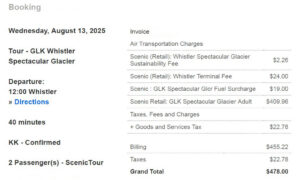
On Sunday 2nd February 2025, just over a week after confirming our Canadian summer holiday, I booked two flight tickets (one for me and one for my son) for Harbour Air’s 40 minute Spectacular Glacier Tour out of Whistler on Wednesday 13 august 2025. At moment of booking, Harbour Air was planning three of these scenic flights on that specific day, so I opted for the 12:00 scenic flight. I paid CAD 478,00 in total, including fees and taxes, which comes down to CAD 239,00 per person (i.e. exactly the minimum fare as mentioned on the Harbour Air website). This equals EUR 325,11 in total, or EUR 162,55 per person. Not exactly cheap for a 40 minute flight, but this would not be an ordinary flight of course, taking into consideration the epic scenery and, well, just flying on a seaplane.
Shortly after finalising my booking on the Harbour Air website, I received a booking confirmation via email. Even though I booked a scenic flight, the confirmation made it clear that Harbour Air considered this flight as a normal scheduled flight and so all passengers would have to prepare for this flight as if it was a scheduled flight. Here is some of the additional information that was stated in the confirmation email I received after finalising my booking:
Checking-in:
- Harbour Air recommends that passengers arrive at the terminal at least 40 minutes before the scheduled departure time.
- Passengers must be fully checked-in 20 minutes before the scheduled departure time.
- Passengers not checked-in before the check-in cutoff times will not be able to board their scheduled flight and will not be refunded their fare. Harbour Air reserves the right to cancel the passenger’s return flights.
Required travel documents:
- All passengers 18 years and above must present either one piece of valid government issued photo identification, or two pieces of government-issued identification without a photograph.
- Physical identification is required. Sorry, we cannot accept copies or photos.
Baggage:
- Guaranteed Baggage is 20 lbs per passenger.
- Baggage over the guaranteed baggage limit is subject to a fee of $1/lb (taxes included) and travels on a space-available, standby basis.
- All baggage counts towards allowance, including purses, briefcases, backpacks, etc.
Changes and cancellations by the passenger:
- More than 24 hours prior to scheduled departure time: cancellations are eligible for refund to original form of payment for all refundable fares, fees and taxes.
- Changes are subject to difference in fare. Less than 24 hours prior to scheduled departure time: cancellations are non-refundable and reservation is nonchangeable.
So, after I had finalised my booking on Sunday 2 February 2025, this is how my itinerary looked like:
| Day | Flight | Origin | STD | Destination | STA | Aircraft Type |
| 13AUG2025 | Spectacular Glacier Tour | YWS | 12:00 | YWS | 12:40 | DHC-3T |
About Harbour Air
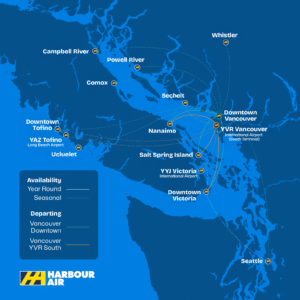
Harbour Air is a Canadian regional airline based in Richmond, British Columbia. It operates a fleet of seaplanes and specializes in scheduled flights (year round and seasonal) as well as scenic sightseeing flights along the Pacific coast of British Columbia.
Harbour Air was founded in 1982 in British Columbia as Windoak Air Service. The airline began its first flight operations (seaplane charter flights for the forest industry in British Columbia) with just two seaplanes and two pilots. By 1984 its fleet had already expanded to eight aircraft. During the late 1980’s and the early 1990’s Harbour Air gradually expanded its activities beyond the industrial charter flights as the airline began scheduled services. In 1993 Harbour Air acquired Trans-Provincial Airlines, allowing the airline to significantly expand its route network including charter flights to resorts. In 1996 the airline started scheduled services between Vancouver and Victoria. Two years later, in 1998 Harbour Air began scheduled services to Nanaimo.
In the early 2000’s Harbour Air acquired Aerospace Services, effectively becoming the airline’s specialized maintenance, repair and overhaul (MRO) division. In 2007 the airline launched Harbour Air Malta, a small subsidiary based in Valletta, Malta and operating scheduled flights to Gozo and scenic sightseeing flights around the islands. In the 2010’s the airline increased its operations by acquiring other airlines such as West Coast Air, Whistler Air and Salt Spring Air. In 2018 it began international scheduled services between Vancouver and Seattle. In the very same year Harbour Air also began scheduled services to Tofino on Vancouver Island. In December 2019 the airline, together with magniX (a company powering the electric aviation revolution), operated the world’s first all-electric commercial flight on the Fraser River near Vancouver with ePlane, a six-passenger De Havilland DHC-2 Beaver, marking the start of the electric age in aviation. In 2024 Harbour Air began scheduled services between Vancouver International Airport and Victoria International Airport on wheeled services.
At moment of writing (August 2025) Harbour Air is the world’s largest all-seaplane operator, operating up to 200 daily flights to 15 destinations with a mixed fleet of De Havilland Canada and Cessna seaplanes.
| DHC-2 Beaver | DHC-3 Single Otter | DHC-6 Twin Otter | Cessna Grand Caravan EX | |
| Fleet | 9 aircraft | 22 aircraft | 4 aircraft | 2 aircraft |
| Passengers | 6 passengers | 14 passengers | 19 passengers | 9 passengers |
| Wingspan | 14,67 m | 17,44 m | 19,81 m | 15,88 m |
| Height | 3,18 m | 3,76 m | 5,49 m | 4,60 m |
| Length | 10,00 m | 13,78 m | 15,85 m | 12,67 m |
| Max altitude | 3.000 m | 3.000 m | 7.620 m | 7.620 m |
| Speed | 180 km/h | 210 km/h | 296 km/h | 287 km/h |
| Power | 450 hp x 1 | 720 hp x 1 | 650 hp x 2 | 867 hp x 1 |
About the De Havilland DHC-3T Turbine Otter
The De Havilland Canada DHC-3T Turbine Otter is essentially a modernized version of the De Havilland Canada DHC-3 (Single) Otter, a single-engined high-wing propeller aircraft with STOL (short take-off and landing) capabilities. The De Havilland Canada DHC-3 (Single) Otter was designed in 1951 by De Havilland Canada as a larger version the earlier De Havilland Canada DHC-2 Beaver, a highly successful STOL aircraft of which more than 1.600 were built by the Canadian aircraft manufacturer.
The De Havilland Canada DHC-3T (Single) Otter made its maiden flight on 12 December 1951 and received certification less than one year later, in November 1952 with production beginning not much later. The De Havilland Canada DHC-3 (Single) Otter kept much of the basic characteristics of its older sibling but the wingspan was larger, its fuselage was longer and it had a more powerful engine, the 600 hp Pratt & Whitney R-1340 radial engine. Like the De Havilland Canada DHC-2 Beaver, the De Havilland Canada DHC-3 (Single) Otter could also be fitted with skis or floats, a testament to the versatility of the aircraft design. A total of 466 aircraft were built. Main military operators include The Royal Canadian Air Force and the United States Air Force, whereas main civil operators include Harbour Air, Kenmore Air and even the Australian carrier Qantas.
As from the 1980’s, some of the De Havilland Canada DHC-3 (Single) Otters got their original engine replaced by a more powerful turboprop engine (either a Pratt & Whitney Canada PT6A-27 or Pratt & Whitney Canada PT6A-34), and as such they were renamed as De Havilland Canada DHC-3T Turbine (or Turbo) Otter. Main advantages of the new engine were a much higher engine reliability (including easier maintenance and longer time between engine overhauls), better perfomance (e.g. in hot conditions but also for short field performance) and lower overall vibration.
About Green Lake Water Aerodrome
Green Lake Water Aerodrome is a public water aerodrome located on Green Lake near Whistler in British Columbia, a famous Canadian mountain resort, attracting tourists from Canada and abroad during both winter and summer season. Its IATA code is YWS while its ICAO code is CAE5. Green Lake Water Aerodrome is located at an elevation of 2.100 feet AMSL and its location coordinates are 50°08’37”N 122°56’57”W. Other nearby airfields are Pemberton Regional Airport (CYPS) and Squamish Airport (CYSE). Green Lake Water Aerodrome does not publish its own METAR weather reports, the nearest METAR station is Vancouver International Airport (YVR / CYVR), located 58 NM south of Green Lake Water Aerodrome.
The main aircraft operator at Green Lake Water Aerodrome is Harbour Air which offers seasonal scheduled flights between Vancouver Harbour Flight Centre (CXH / CYHC) and Green Lake Water Aerodrome as well as seasonal scenic sightseeing flights from Green Lake Water Aerodrome, including the Harbour Air Spectacular Glacier Tour.
Harbour Air Spectacular Glacier Tour
As already mentioned in the very beginning of this trip report, this scenic flight was part of a family summer holiday in Canada. Exactly one week earlier we had already flown with Air Canada from Belgium to Calgary via Toronto and during our roadtrip we had already made several stops in magnificent places such as Banff, Jasper and Clearwater.
On Tuesday 12 August 2025, i.e. one day before the scenic flight with Harbour Air, we already drove from Clearwater to Whistler as part of our travel itinerary. After being on the road for quite a few hours we finally arrived in Whistler in the late afternoon. We stopped at our hotel where we would spend two nights, checked in and parked our rental car in the (massive) underground parking. Then it was time to begin our first exploration of the village of Whistler. Something we immediately noticed was the great and unique atmosphere. It seemed like everyone in Whistler was outside and enjoying an adventurous outdoor activity. We saw hundreds of mountainbikers arriving back in in the village after a great ride in the mountains surrounding Whistler. We continued our exploration of Whistler and after exploring some shops and having a tasty dinner in a nearby restaurant, it was time to call it a day and get some sleep.
The next day, i.e. Wednesday 13 August 2025, I woke up early and immediately felt quite excited. After all, today would be the day that I would finally be able to check off my bucket list item and actually get to fly on a seaplane. But first we had to get some breakfast of course. We made our way to the Starbucks cafe in downtown Whistler and after having some tasty croissants and a caffè latte, it was time to get back to the hotel so I could make my final preparations for the seaplane flight.
At around 10:40 and after one last (photography) gear check (including my smartphone and my Canon camera of course), we made our way to the underground parking. Few moments later we were already on our way to Green Lake Water Aerodrome, located just 4 kilometers north of Whistler. After a five minute drive on the BC-99 Sea-to-Sky Highway in a northerly direction, we took the highway exit and arrived at the Green Lake Water Aerodrome.
At first, Green Lake Water Aerodrome did not appear to have a car parking of its own. However, as we drove up to the nearby roundabout, we noticed a small wooden placard indicating that Harbour Air scenic flight passengers could park their car at the nearby Nicklaus North by Whistler Premier Hotel. Indeed, when arriving at the car park of this hotel, we informed the female steward on duty that we were Harbour Air passengers and she immediately opened the barrier for us and explained in detail where we should park our car.
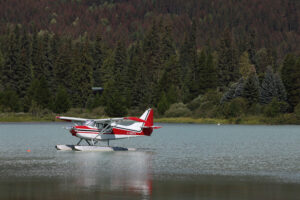
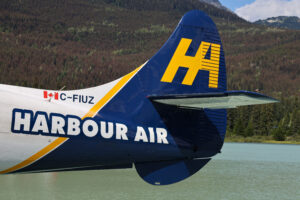
At 11:00 we parked our car and after taking all our photography gear and personal belongings, we made our way to Green Lake Water Aerodrome, located just two hundred meters or so from the car parking. When we arrived at Green Lake Water Aerodrome we immediately noticed a Harbour Air seaplane, De Havilland Canada DHC-3T Turbine Otter C-FIUZ, which was already docked. Furthermore, some Harbour Air ground staff members were already very busy with refuelling the aircraft and doing some aircraft checks. That’s when it became clear to me that this aircraft would be the seaplane we would be flying on.
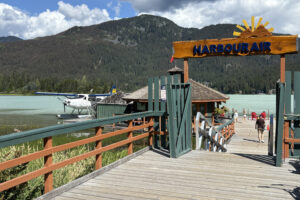
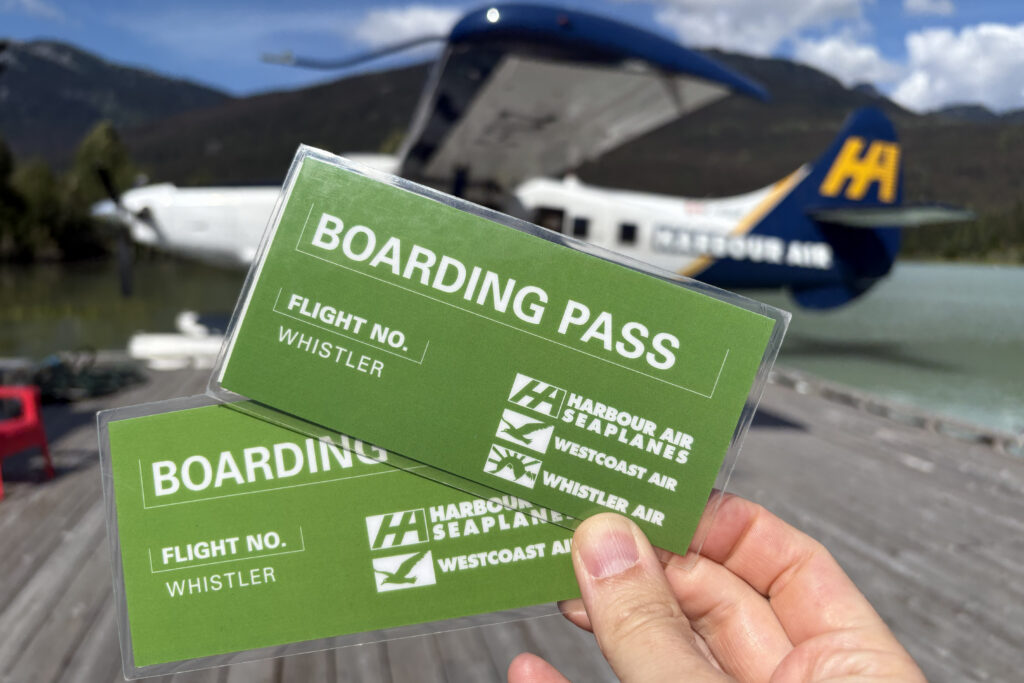
We entered the aerodrome’s only small wooden building, where we were kindly welcomed by other Harbour Air ground staff members. After checking our names and the flight we were scheduled to fly on, we received two reusable laminated boarding passes for our flight. Before getting back outside however, I asked one of the Harbour Air ground staff members if there was any chance of me getting a seat next to the Captain in the cockpit. Fortunately the ground staff member answered me that there was definitely a possibility but that I needed to check this with the Captain himself.
As there was still plenty of time left before our flight would leave, we went back outside, sat down on a bench and enjoyed the local scenery for a while. The weather seemed to be quite favourable for our seaplane flight. Lots of sunshine, blue skies, a rather good visibility and just a few cumulus clouds in the vicinity. Yes, it definitely appeared to be a good day for flying on a seaplane.
I wanted to take some more photos of the surroundings as well as another seaplane on the lake, so I made the short walk back to our rental car car to pick up my Canon RF 100-500mm zoom lens. I walked back to the lake and made a few photos of the lake and another seaplane (a Stinson 108-3 Voyager). After finishing my mini photoshoot, I walked back to the rental car again to drop off my lens again, since I would not need it for the scenic flight.
The minutes passed by and more and more passengers started to turn up for the twelve o’clock scenic seaplane flight. We even noticed some non-passengers making their way to the the aerodrome docks to get some close-up views of the cool Harbour Air seaplane. After all, most of us don’t get to see a seaplane every day (unless when you’re living in British Columbia, Canada).
At around 11:45 the Harbour Air ground staff members requested all passengers for the lunchtime scenic flight to queue in a single line so we could enjoy a smooth boarding. Few moments later the Captain of our flight showed up, wearing a traditional pilot shirt with four bar epaulets. He welcomed us, introduced himself and explained us some important safety items before we could board the seaplane. As we were the very first passengers to board, I was first in line to ask the Captain’s permission to sit next to him in the cockpit. Fortunately, he did not mind at all and so I was kindly invited to take a seat in the front row. This was a dream coming true, I can tell you that.
Before boarding our aircraft , the Captain still wanted to check how many separate groups were flying on the scenic flight, since this would allow him to get an overview of all passengers and to make sure that every passenger could get a good seat next to a another member of his or her group, while also making sure that everything would be within safety limits. As said, I would join the captain in the seat next to hime in the cockpit, and my son would sit just behind me in a normal passenger seat in the main cabin (yes, I did ask him first if he did not want to get the cockpit seat instead of me, but he knew how much it would mean to me so he didn’t mind at all). After all aircraft seats were allocated, the Captain finally invited us to board the aircraft so that we could depart as soon as possible.
By now it was 11:50 and all passengers had safely boarded the seaplane. It was time to close the doors and get everything ready for our scenic flight. The Captain welcomed all passengers once again and took a portable tablet so he could show the mandatory safety demonstration to all passengers. After all passengers in the cabin had viewed the safety demonstration, the Captain handed the his tablet to me, so I could also watch the safety demonstration items that I needed to see. One item that you don’t get to see in a safety demonstration video on a regular aircraft for instance, is that we had to put on two seatbelts instead of just one, i.e. a blue and a yellow seatbelt. The blue seatbelt was the normal seatbelt while the yellow seatbelt was attached to a life vest. This enables passengers, in case of an emergency landing on water to quickly evacuate the seaplane while already wearing an inflatable life vest.
After all mandatory safety inspections were completed, the Captain ran his before engine start checklist and checked that all aircraft systems were operating as expected and within limits. Few moments later the Captain started our engine and De Havilland Canada DHC-3T Turbine Otter C-FIUZ came to life . The massive propeller began to move and I’m sure there was an instant smile on my face just from hearing the sound of this aircraft’s Pratt & Whitney PT-6A turboprop engine.
While our seaplane was still docked, I was invited by the Captain to put on a headset (only available for the passenger sitting in the cockpit seat next to the Captain) as this would enable me to hear live air traffic control communication throughout the entire flight. A nice extra bonus of sitting in the cockpit next to the Captain. This was exactly the kind of seaplane experience I had been hoping for, ever since I booked tickets for this scenic flight.
Few moments later it was time to get going. The rope securing our seaplane was untied by one of the Harbour Air ground staff members while communicating with the Captain, as he put the propellor blades of our De Havilland Canada DHC-3T Turbine Otter in a negative pitch in order to ‘push away’ from the dock. After this very interesting manoeuver the Captain gave some more information to the passengers of the takeoff procecure. Due to winds blowing from the south, we would first taxi all the way to the northern side of Green Lake, followed by a takeoff in a southerly direction. Or, to quote the Captain: “For the next seven minutes we’ll be a boat on a lake.”
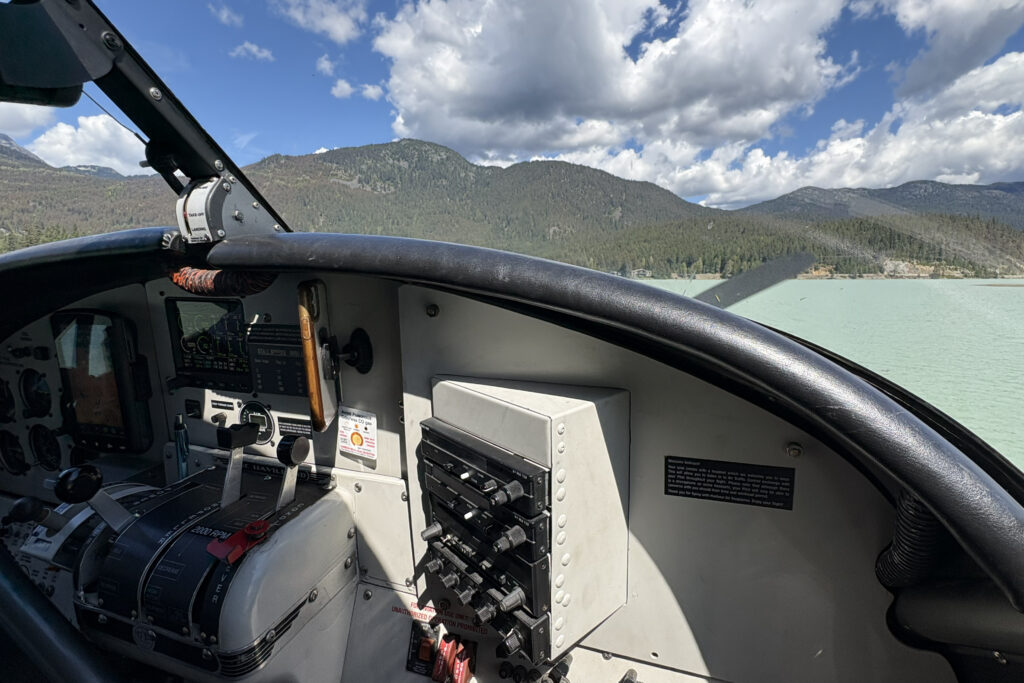
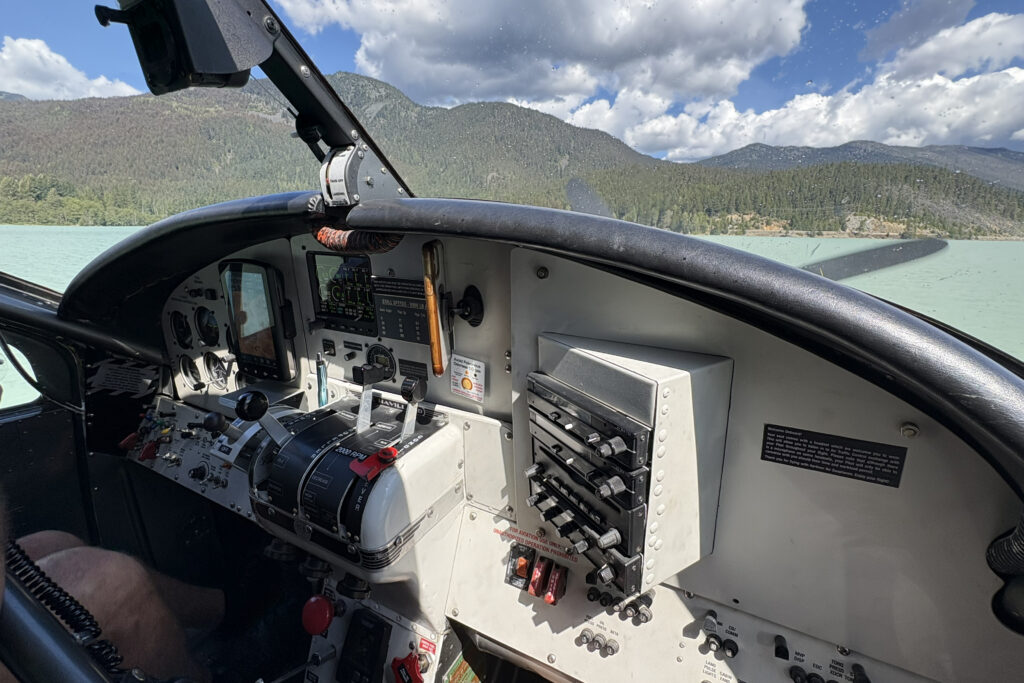
As we were taxiing to our takeoff position on Green Lake, I noticed that the Captain was already communicating with other air traffic in the vicinity, not only to give them details of his intentions and our exact position (we were still on the lake of course), but also to get some detailed information on the meteorological conditions (visibility, winds, tubulence,…) at certain interesting locations. Green Lake Water Aerodrome is an uncontrolled aerodrome, so there are no air traffic controllers giving instructions and clearances to flights operating in and out of Green Lake. Instead, pilots report on prescribed radio frequencies who they are, where they are and what they are about to do next (for instance: “Harbour Express 306, taking off from Green Lake Water Aerodrome in a southerly direction at 80 kts and climbing to three thousand feet”). This allows other pilots to maintain a good view of the position and speed of nearby air traffic, which increases safety.
At 12:07 local time (Pacific Daylight Time or PDT) (UTC-7:00), our Captain pushed the power lever, located on the throttle quadrant, forward to increase power. We could immediately feel the acceleration as our groundspeed (or should I say ‘waterspeed’?) began to increase. I really noticed the difference between taking off from a normal runway (or even a sandy beach, as I flew to Barra in Scotland in late 2019, see my separate trip report) and taking off from a lake with a seaplane. You could really feel how both floats were slicing through the water on the lake, quite a unique experience I have to say. At first the seaplane seemed to be accelerating a bit slower than a normal aircraft, but a few moments later the speed increased quite fast.
Less than half a minute later, I felt a subtle change in pitch and our vertical speed indicator began to indicate a slow climb. We had taken off from Green Lake Water Aerodrome. This was my first ever takeoff in a seaplane. What a great feeling! Shortly after takeoff I looked outside the right hand side window and saw the BC-99 Sea-to-Sky Highway getting smaller and smaller as our De Havilland Canada DHC-3T Turbine Otter gained altitude. By the time we reached the western shore of Green Lake near Alta Creek and Alpine Meadows, our Captain decreased the propeller lever so we could safely climb away from Green Lake.
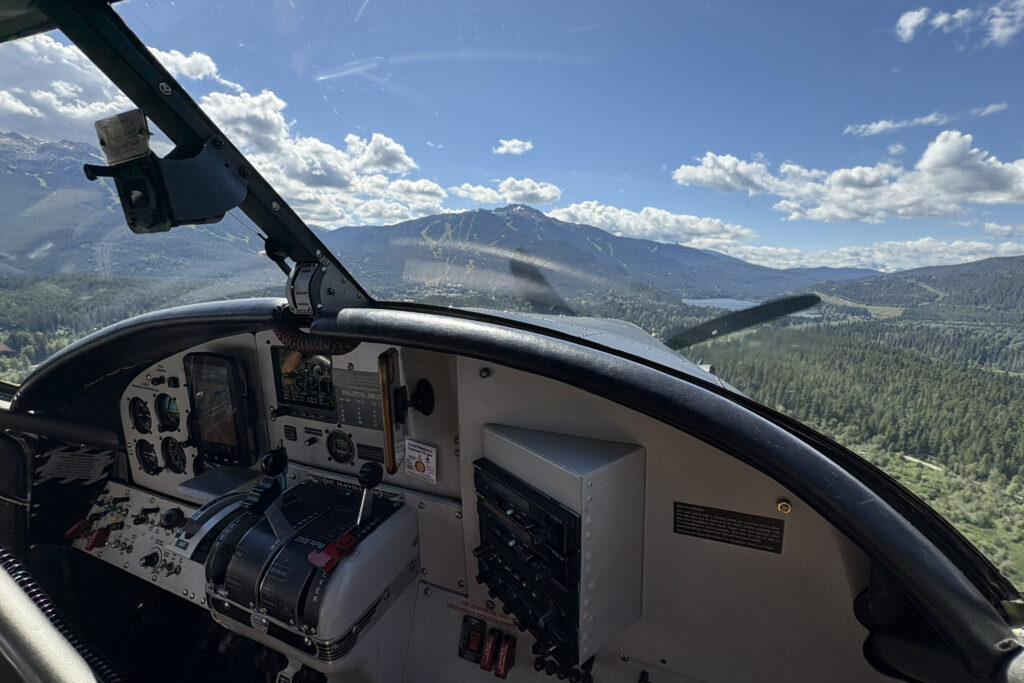
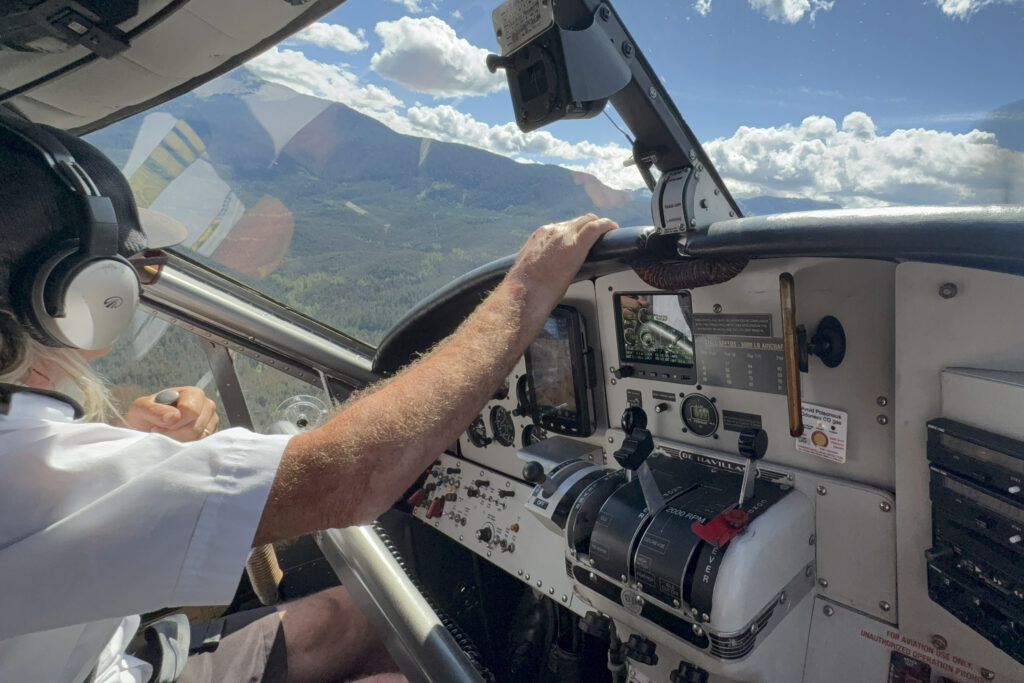
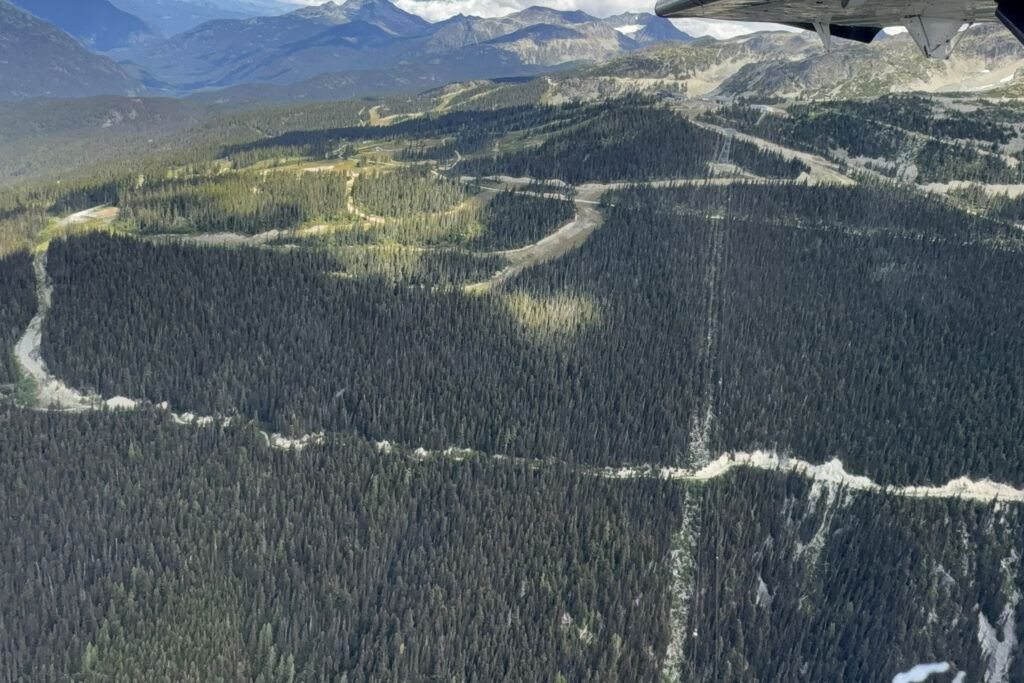
Less than a minute after our takeoff from Green Lake, De Havilland Canada DHC-3T Turbine Otter C-FIUZ was flying over land and things started to get a bit bumpy, as could be expected when flying through mountainous topography with a small turboprop aircraft. We continued our slow climb (just a few hundred feet per minute) out of Green Lake in a westerly direction. I got some magnificent views of Mount Sproatt, a mid-elevation peak located just west of Whistler, in British Columbia’s Coast Mountains. We also flew just north of Whistler but unfortunately I did not get any good views.
Few moments later we were still climbing out of Green Lake, and were flying along the BC-99 Sea-to-Sky Highway near Sproatt. The Captain of our scenic flight made a left hand turn to put our De Havilland Canada DHC-3T Turbine Otter in a southeasterly direction, straight into the Cheakamus River valley towards Cheakamus Lake in Garibaldi Provincial Park.
Garibaldi Provincial Park is one of British Columbia’s biggest provincial parks with a surface of nearly 2.000 square kilometers. It is home to the 2.678 meters high peak Mount Garibaldi and is known for its overall natural beauty and numerous hiking trails (more than 90 kilometers in total), but also features many fabulous mountain summits and glaciers. Large mammals such as mountain goats bears, deer, cougars and wolverines also live in this provincial park.
Back to our scenic flight now. As we turned into the Cheakamus River valley, we flew just next to some cliff edges on the lower side of Mount Whistler. Quite spectacular I must say. You don’t get to do this where I live, that’s fur sure. We were only flying for maybe five or ten minutes, but the views were absolutely stunning and the overall flying experience was second to none. This was definitely a dream come true. What an adventure, what a ride. Unfortunately for some passengers in the back, the ride remained quite bumpy as we were now flying in a very mountanous area. Because of the turbulent air and occasional bumps, the flight was not very comfortable, but I did not really mind as that was not really the main purpose of this great scenic flight. On the contrary, the bumps added to the overall adventurous experience of this scenic flight. Anyway, we continued our climb on the western edge of Mount Whistler, so I got some more great views of Cheakamus River in the valley below. After a few more minutes we were already approaching Cheakamus Lake and got some more great views of Mount Whistler on the left side of the aircraft (one of the perks of a cockpit seat is that sometimes, you can enjoy spectacular views on both sides of the aircraft).
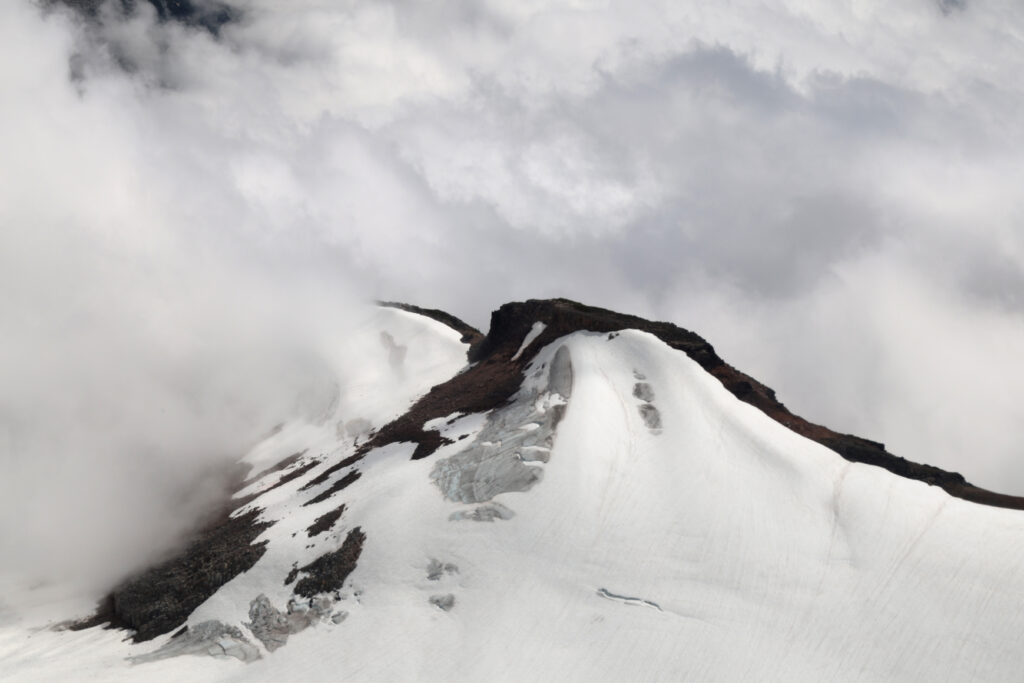
By now we were flying directly over Cheakamus Lake. Our altitude had increased significantly and we could already enjoy some fenomenal views of the surrounding mountains including Mount Davidson and Castle Towers Mountain. Few moments later we made a right turn and flew directly towards these two mountains and the spectacular Cheakamus Glacier located precisely between these two majestic mountains. Once again I looked outside the right hand side window and I got some more great views of Cheakamus Lake featuring its almost surreal blue water. We continued our flight in a southerly direction and few minutes later we were flying abeam the summit of Mount Davidson where I got some epic views of the snow covered mountain tops. By now the cloud coverage had increased slightly and so had the turbulence. The ride was absolutely spectacular and so were the views. By now clouds were both above and below us, and our Captain was communicating with other aircraft in the vicinity to check the visibility and turbulence at other scenic points.
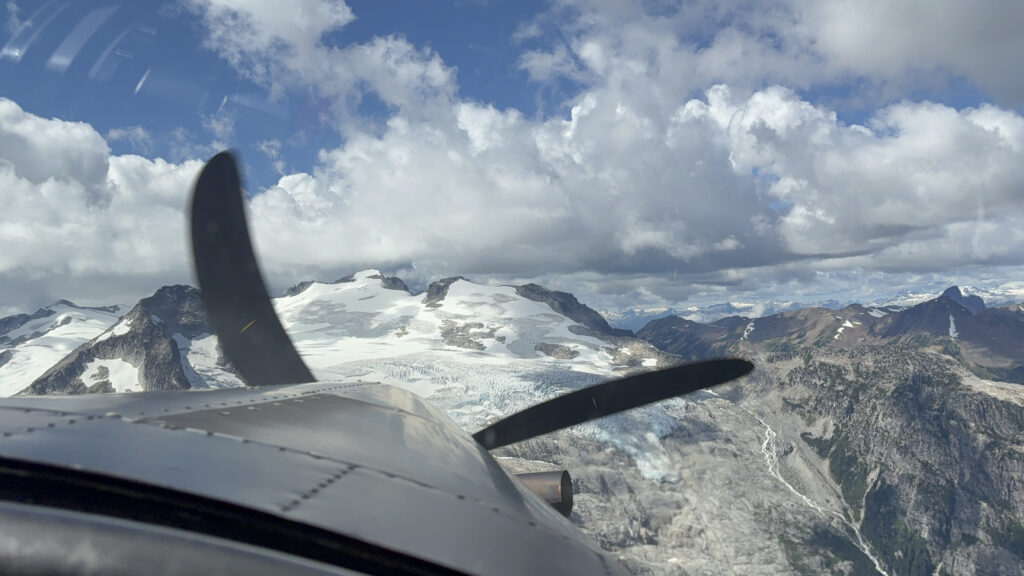
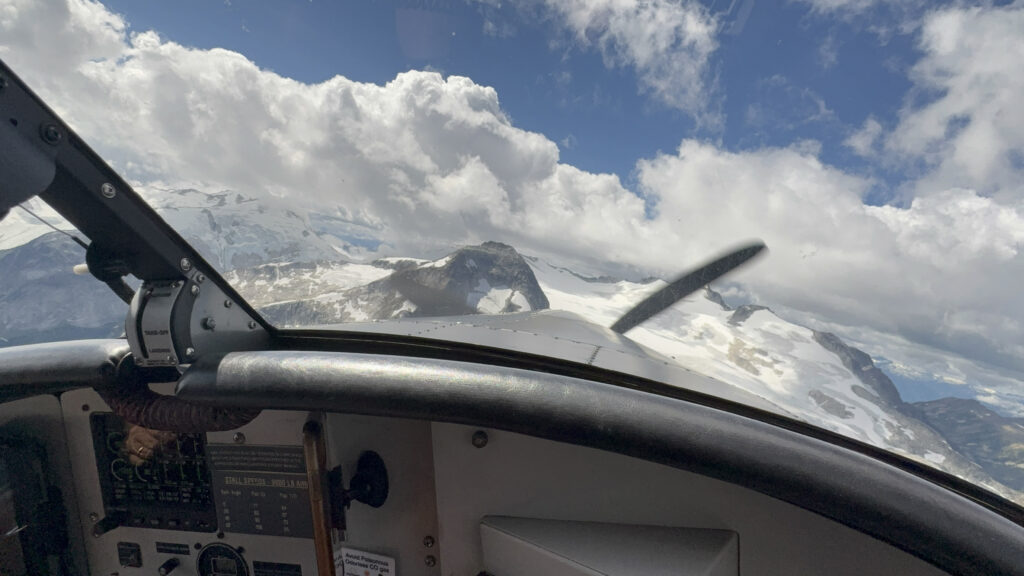
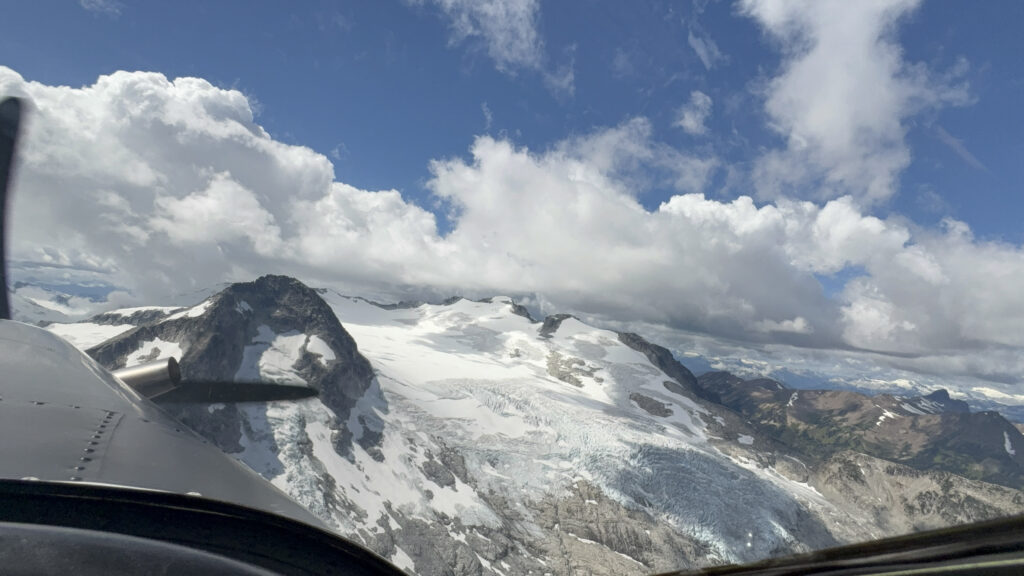
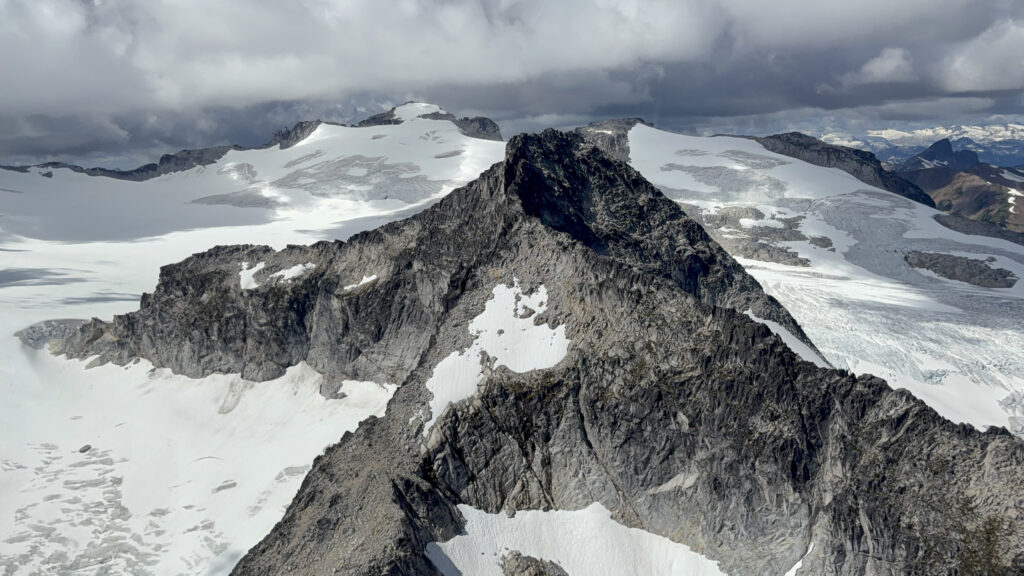
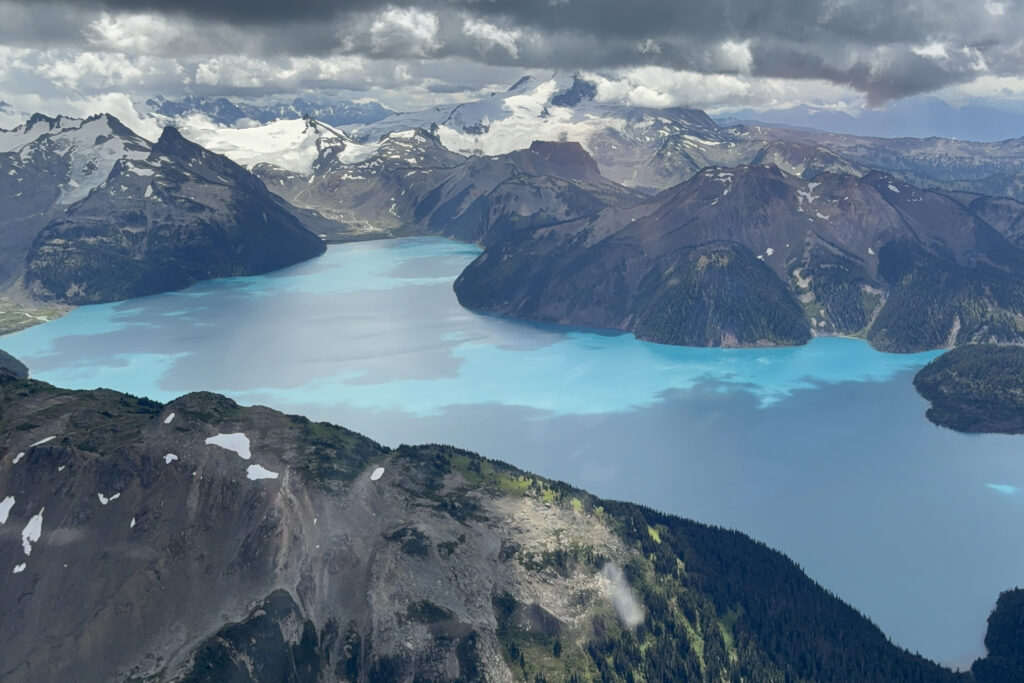
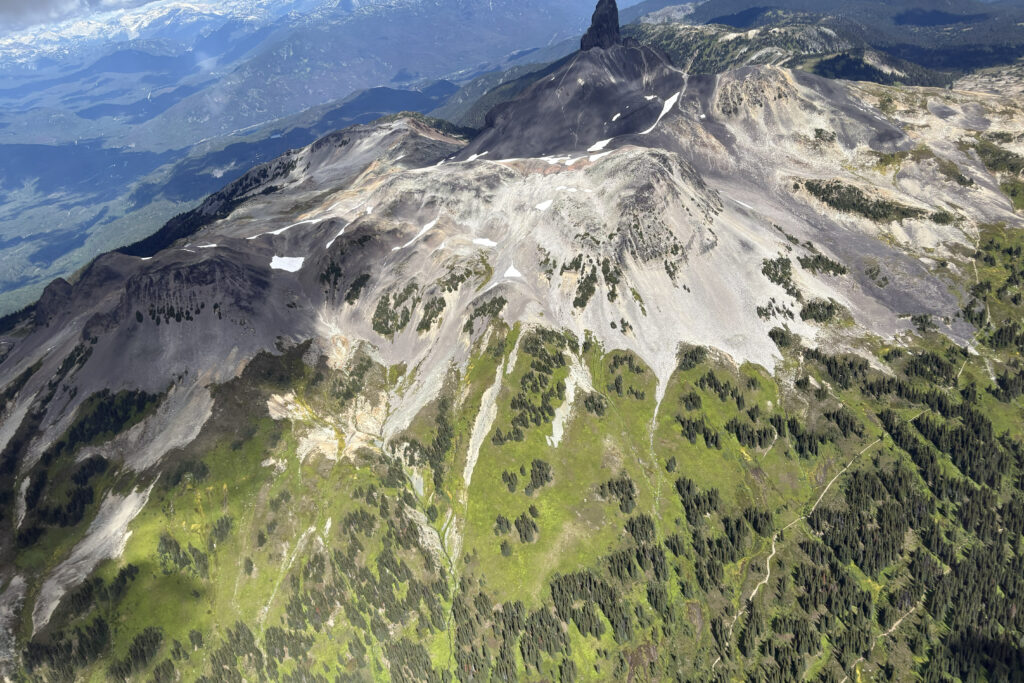
We continued our flight over the magnificent mountain tops and glaciers (such as Phoenix Glacier) of Garibaldi Provincial Park as the Captain of our De Havilland Canada DHC-3T Turbine Otter made several turns left and right, to offer every passenger the best possible view of the scenery. At 12:26 local time (Pacific Daylight Time or PDT) (UTC-7:00) we were already flying over Lake Garibaldi at an altitude of 8.000 feet with an airspeed of around 120 knots. After enjoying some great views of the lake from above, our flight continued toward Black Tusk, the remnant of an ancient volcano. Its dark, jagged edges make it quite a spectacular landmark of the Garibaldi Provincial Park. Black Tusk is a stratovolcano and pinnacle of volcanic rock in Garibaldi Park and is a popular hiking destination in the park. We made another right turn near Black Tusk and made our way back to the southeast over Lake Garibaldi while also enjoying good views of Panorama Ridge, another well-known hiking destination at Lake Garibaldi, offering great scenic views of the lake.
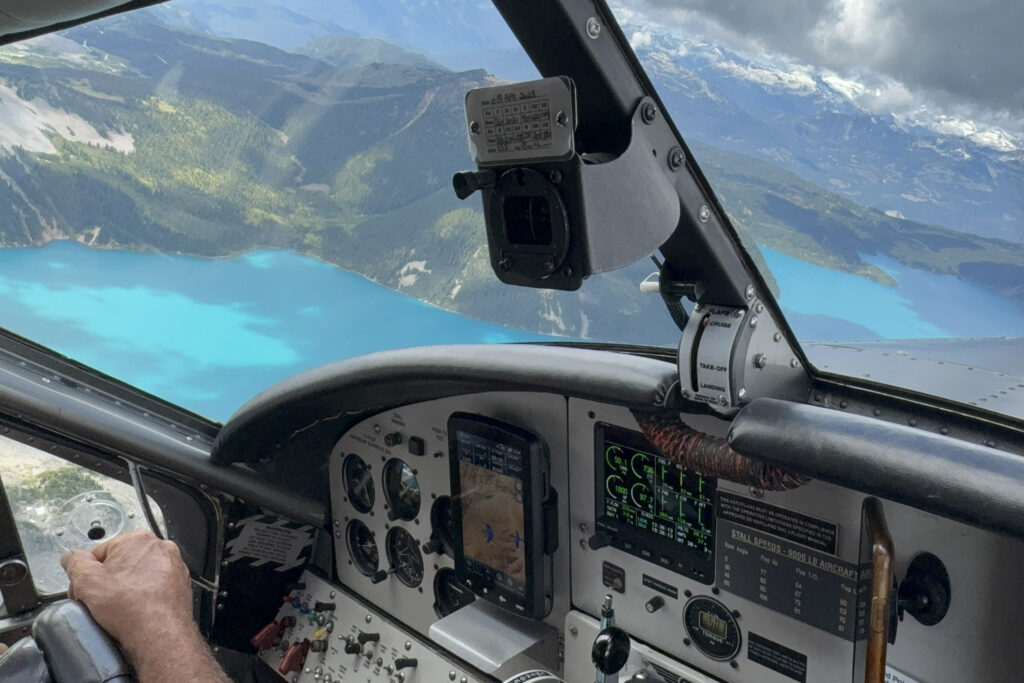
We had been flying for quite a while already, so unfortunately it was time to fly back to Green Lake Water Aerodrome. We set course for Cheakamus Lake and flew just next to some impressive mountain ridges of Castle Towers Mountain that were still partially covered with snow on one side. Few moments later we were flying over Cheakamus Lake again. We continued our flight and passed Whistler Mountain on our left side, as De Havilland Canada DHC-3T Turbine Otter C-FIUZ made its way to the valley between Whistler Mountain and Blackcomb Mountain, probably the two most impressive mountains near Whistler. As we reached the valley, we gradually descended towards the BC-99 Sea-to-Sky Highway and Green Lake.
Few moments later we were already flying over the well-known Peak 2 Peak Gondola, an impressive gondola connecting Whistler Mountain and Blackcomb Mountain and one of the main sightseeing attractions for tourists (and adventurers) visiting Whistler. The Peak 2 Peak Gondola was constructed in 2007-2008 and covers a distance of 4.4 kilometers. It was the first gondola connecting two side-by-side mountains. At moment of writing it still sets the record for taking its passengers to the highest point above the ground in a gondola (436 meters). From a ground perspective, the Peak 2 Peak Gondola seems a really high (and maybe even terrifying) gondola, but when looking down from our De Havilland Canada DHC-3T Turbine Otter C-FIUZ as we descended towards Green Lake, it did appear quite small and insignificant.
We continued our descend towards Green Lake Water Aerodrome in a northerly direction and flew just next to Blackcomb Mountain, a 2.444 meters high mountain located southeast of Whistler and known for the Whistler Blackcomb Ski Resort, offering North America’s highest lift-accessed terrain and an abundance of challenging skiiing opportunities, including steep descents and glacier skiing. As our scenic flight was taking place during the summer season, we did not get to see much snow on the slopes of Black Mountain of course, but we still got to see plenty of mountainbikers going downhill on one of the many of the mountainbike trails.
We were flying close to Whistler and got our first glimpse of Green Lake again. It was time to get prepared for our water landing (also my very first water landing as you might have already guessed by now). We continued our descent and made a right turn to fly a left downwind leg for the approach to Green Lake Water Aerodrome. The approach to Green Lake was quite spectacular, offering stunning views of the lake itself as well as the many surrounding green forests and mountains.
At 12:38 we were flying on the left downwind leg for a landing on Green Lake. Both our speed and altitude had been decreased and flaps were set gradually for our water landing. Few moments later we made a left turn towards the base leg, followed soon by another left turn to get on final approach for our water landing on Green Lake. I continued to enjoy the fabulous views of the area as I realised that I would probably never get to experience such an amazing scenic flight ever again. I monitored the Captain flying the aircraft during the final approach phase. Power was reduced gradually while the propeller lever had already been set to full forward. During the turn from base to final, the Captain pushed his yoke a bit more forward to reduce our altitude so we could land safely on Green Lake. During the final approach I enjoyed the fenomenal views of Green Lake and the BC-99 Sea-to-Sky Highway just next to it.
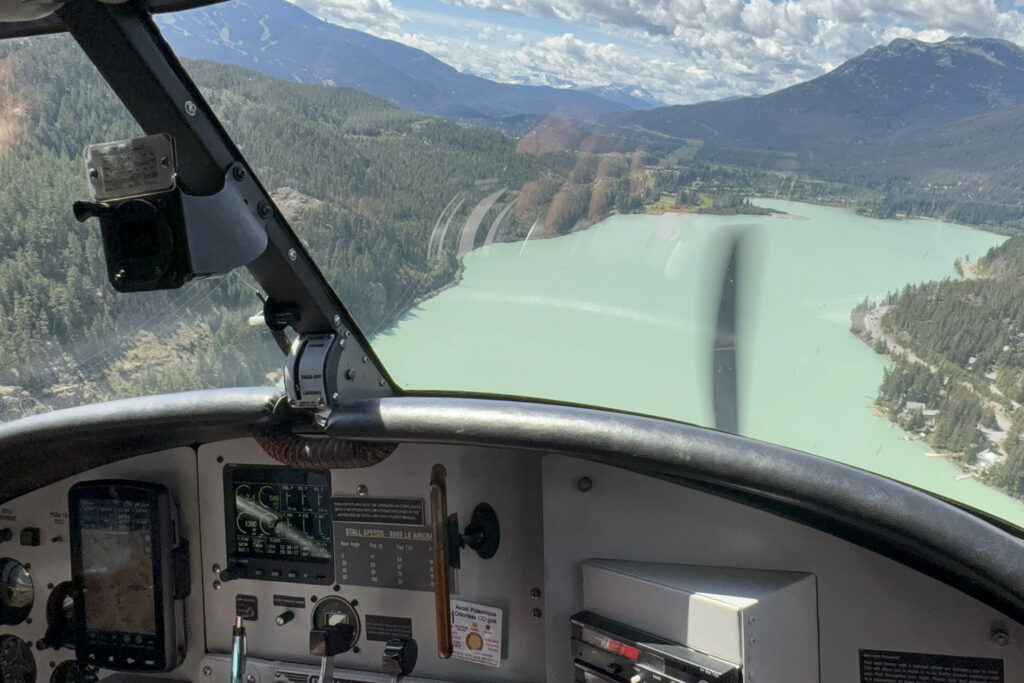
At 12:39 local time (Pacific Daylight Time or PDT) (UTC-7:00) and after one last gentle right turn just above Green Lake, power was set to idle and the two floats of De Havilland Canada DHC-3T Turbine Otter C-FIUZ touched the water of Green Lake as the Captain made a soft water landing. Our speed decreased and just ten seconds later our speed had already dropped significantly as I noticed the water of Green Lake splashing next to our two floats. My very first water landing was a success!
After a short taxi, we arrived at the docks of Green Lake Water Aerodrome. Before coming to a complete stop, our Captain opened his door to check for a safe docking of De Havilland Canada DHC-3T Turbine Otter C-FIUZ. Few seconds later, we came to a complete stop at the docks and our Captain set the power lever to IDLE immediately followed by pulling the condition lever all the way back to IDLE CUT OFF. The propeller of our aircraft stopped spinning as our turboprop engine was shut down. The Captain continued his engine shutdown procedure and few moments later he kindly welcomed all passengers back to Green Lake Water Aerodrome.
Unfortunately, our scenic flight had come to an end. I thanked the Captain of our flight for a good flight and an amazing experience. This was the cherry on the cake of an already stunning holiday in Western Canada. It was time to leave the seaplane as the next load of passengers seemed to be already waiting impatiently to board the seaplane for their scenic flight. We vacated the aircraft and took some more photos of De Havilland Canada DHC-3T Turbine Otter C-FIUZ. We had a nice chat with some other passengers of our scenic flight who also realised that we had just experienced a great scenic flight in overall very good conditions.
We said goodbye to the other passengers and made our way back to the main building of Green Lake Water Aerodrome for some mandatory souvenir shopping, just to remind ourselves, many years from now, of the epic adventure we had just experienced. After the shopping, it was time to head back to our car and drive back to Whistler for some early afternoon lunch and to continue our visit of this great Canadian summer adventure location.
Thank You
I would like to thank Harbour Air for operating these scenic sightseeing flights, the entire crew at Green Lake Water Aerodrome for their great service and Captain Paul for a stunning flight over some of Canada’s most breathtaking mountain sceneries.
13 August 2025